This “Grecian Corner” Is a Local Treasure
Posted by estiator at 12 October, at 17 : 19 PM Print
COVER STORY
Angelo Ballas builds on a family legacy in Winston-Salem. By Michael Kaminer
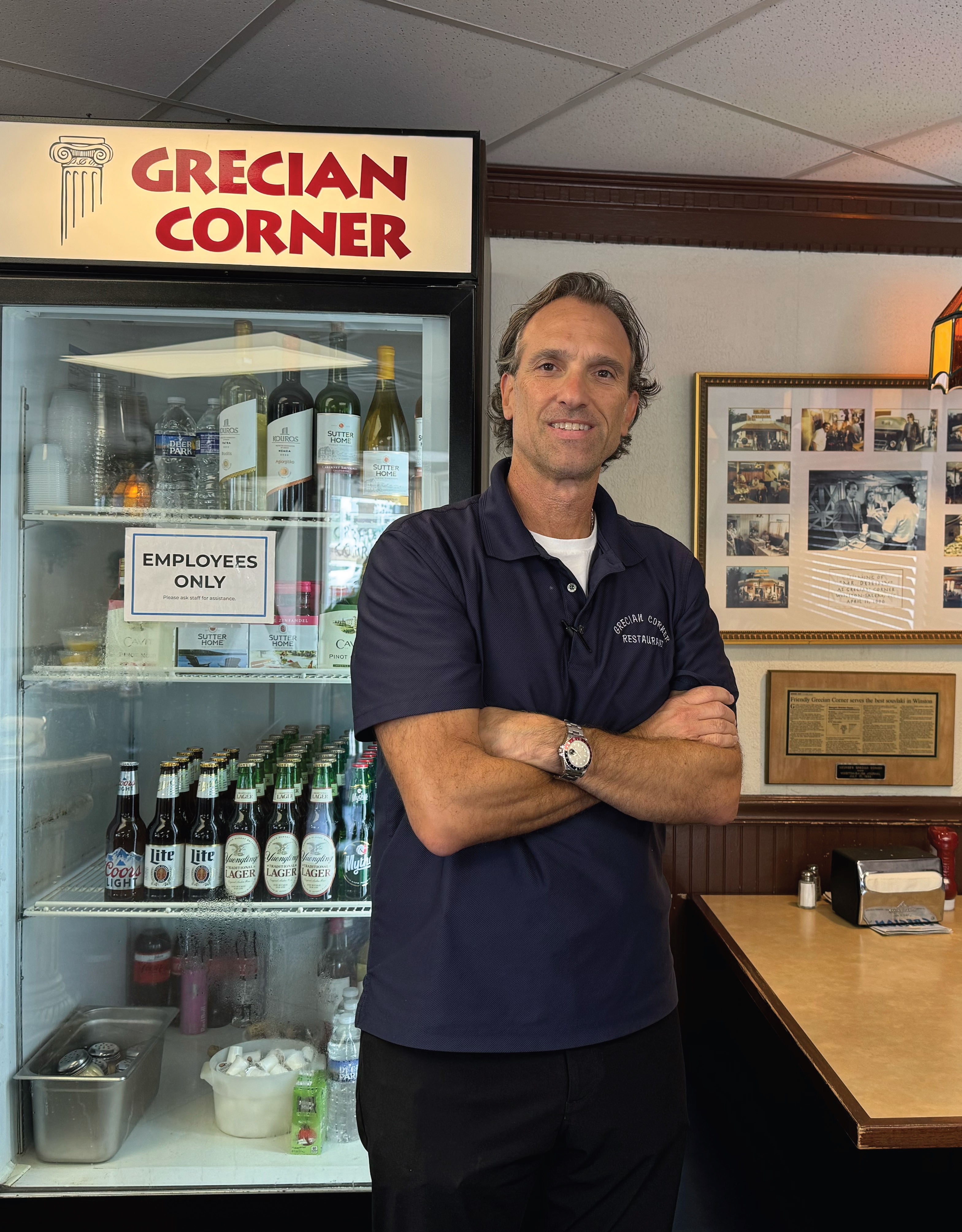
When a local public radio station decided to explore the history of Winston-Salem, North Carolina’s sizeable Greek population, its reporter chose to tell the story through the experience of Angelo Ballas.
It was a smart choice. Ballas’ restaurant, Grecian Corner, embodies the aspirations and successes of the region’s Greek immigrants. And the perennially packed eatery, which opened in 1970, reflects the hard work, family connections, and philoxenia that have made so many Greek-run restaurants success stories.
Ballas, who comes from a family of estiators, took over Grecian Corner in 2001; the restaurant was founded by his late uncle, Gus Ballas. Ballas’ parents, Gus and Soula, owned Steven’s Restaurant in Arcadia, just outside Winston-Salem. His father hails from Evrytania; his mother, from the Peloponnese. Both emigrated in 1955, following Ballas’ grandfather, who arrived in 1951. Soula’s family settled in Daytona Beach, Florida, where her parents ran the Delta Restaurant.
“I started busing tables at 12 years old on the weekends,” Ballas tells Estiator from Winston-Salem. “In college, I came home almost every weekend to work, and I ran a seafood restaurant for 15 years after that. A bagel shop followed, for five years, until my uncle became ill. I sold the shop to buy Grecian Corner.”
As he learned, Ballas was buying more than a place to eat. Grecian Corner was a local institution, with regular customers who would order the same items week after week, or day after day. The restaurant now has 17 employees, some of whom have been with Ballas for more than two decades. “I have really dedicated people. Otherwise, I would pull the rest of my hair out,” he says. Customers get attached to servers after so many years, which is both a blessing and a challenge, he says. “You know how it is when regular customers see a new face. All of a sudden, the Pepsi tastes different and the fries taste different, until they settle in.”
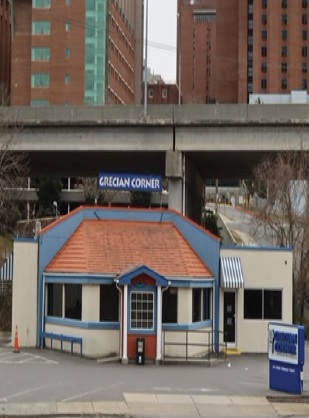
The restaurant still operates from its original location, once a Minnie Pearl’s Fried Chicken franchise. Any change to the food, menu, or room comes with much thought and consider- ation, Ballas says.
“When I took over the restaurant, it had 48 seats, which was inadequate. In 2013, we changed the configuration, adding a whole new dining room with indoor bathrooms, which we didn’t have, along with a stockroom,” he recalls.
But the expansion didn’t take place until Ballas polled Grecian Corner customers, asking if they’d prefer a shiny new building nearby or an expansion of the original location. “They overwhelmingly said we should stay here rather than start anew,” he says. “There’s a warm family feel, which we still hear all the time. You don’t want to lose that.”
Ballas did hire a designer for the expansion; the mandate was “something new, but tying in the old. We changed the color scheme a bit. We used the same light fixtures, which look like little lanterns, because so many people commented on them. We didn’t even change the front counter, but added a new top. It’s where we greet our customers, and it’s a familiar part of the experience of walking in.” Another untouched part of the restaurant: a booth that appears in the 1990 Michael Caine/ Courteney Cox comedy Mr. Destiny, filmed partly here. “A lot of people want to sit there. There are photos of my uncle and the crew, along with scenes of the movie,” Ballas says.
The same goes for Grecian Corner’s menu, whose hero item is a chicken souvlaki platter with a Greek salad. “It’s our number-one item, and we sell many thousands of them a year. Chicken is hand-skewered. There’s no machine. I don’t know what would happen if we changed it,” he says, laughing. The restaurant also features Mythos beer and two Greek wines, a red and a white from Kouros.
When Ballas does add to Grecian Corner’s food selection, “I always put it on for a limited time,” he says. “We’ll put out table tents letting people know about it, and if we get a positive response, it’ll find itself on the menu. But I have a hard time at this point introducing new things, even this many years later. Customers are coming here for a special thing they’ve been getting for years and years. They’ll say, ‘My grandparents brought me in here, and now I’m bringing my own grandkids.’”
Ballas’ own family is now involved in Grecian Corner. His daughter, Athanasia, oversees the restaurant’s social media. Wife Georgia, who doesn’t work in the business, still contributes; before the pandemic made third-party delivery and online ordering a must, she convinced Ballas to make it available. “We’re now 55 percent takeout and 45 percent dine-in. Third-party delivery has become a significant part of our business. We started the process with ChowNow the November before Covid. It turned out to be good for us.” Ballas has since added DoorDash as a vendor. The Ballases also have a son, Dean.
Success hasn’t meant that Ballas is standing still. Grecian Corner launched a food truck in April. “I’d been thinking about it for a decade. We’re located within walking distance of a hospital. When they moved their medical school to another location downtown, I thought, We have to get in front of those people. I didn’t want another restaurant, so a food truck made sense. For a while, I couldn’t find the right time or the right vehicle. Then a truck basically fell into my lap,” he says. Promoted via Instagram and Facebook, the truck makes occasional street appearances and has found success at corporate and school events. “We’ll also set up in front of downtown office buildings if companies request it. It’s as much as advertising vehicle to get people into the restaurant,” Ballas says.
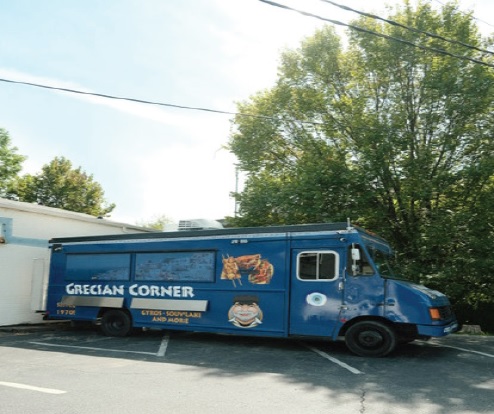
Catering has also proved a successful extension of Grecian Corner’s business. “Because of the limited amount of seats when I took over, I needed to find more ‘seats’ to expand. That’s when the catering idea was born. I started calling pharmaceutical salespeople, since we are located right below a major hospital. Little by little, they gave me a chance to cater their meetings at the hospital. From there, I went to different businesses, dropping off business cards and menus. Eventually I needed to buy a delivery van to handle all the orders, as my personal vehicle wasn’t big enough. It’s now 15 percent of our business.”
While advertising is a driver, word of mouth remains the main source of customers for Grecian Corner. Having a close-knit Greek community in Winston-Salem also helps. “I would say 90 percent of our Greek parishioners are from the same area of Greece, which is pretty unusual for a Greek community in the U.S.,” he says. “Our church, Annunciation Greek Orthodox Church, is the glue and the foundation for all of us. I was at a parish meeting last night, and of the 13 there, just one was not involved in a restaurant. If we’re not related, everyone feels like family.”
But success has come at a cost, Ballas says. “Anyone would agree it’s a tough grind and not conducive to having a family. You have to live it and breathe it, and that means making sacrifices. I’ve been fortunate enough to have good people so I don’t have to live in the restaurant, but it’s not like that for a lot of others,” he says. “Opening a new restaurant from scratch would be tough. I’d tell someone just starting out to buy a restaurant with the infrastructure and bones to build on, but it’s still tough.”
He would also advise newcomers to the industry to “decide your cuisine, have a limited number of menu items, and do them all well. Big menus invite waste,” he says.
As Estiator readers know, labor remains a challenge, Ballas says. “And insurance is going crazy. Prices on certain items continue to increase. And trying to keep your place as clean as possible is always a challenge. If you have new people, you have to educate them on all the rules and regulations. If you’re opening a restaurant just because you love to cook, I’d say you’re crazy.”
But Ballas has found a winning formula by staying true to what Grecian Corner has always been—and to Greek values of hard work and hospitality.
“We’re a simple, comfortable place. Consistency for me has been paramount, from the time I took over. I want to make sure people receive today what they got last week. People know what they’re getting, at a fair price. And we treat people the way we would want to be treated. That’s the golden rule. Follow it, and everything will work out.”
Winston-Salem’s Secret Greek History
“In Winston-Salem, Greek restaurants are almost as ubiquitous as fast food,” a local public radio station reports. Along with the beloved Grecian Corner, diners in this city of 256,000 are spoiled for choice, with options with names like Greek Guys Grill, Kalamaki Authentic Greek Street Food, Mad Greek Grill, Olive Tree Deli, and Greek Village Market.
According to WFDD radio, the story of the Greek restaurant scene in Winston-Salem actually begins more than 100 years ago, with a young immigrant named Alex Kiriakides. That’s according to Dr. Michael Wakeford, an associate professor of history and humanities in the Division of Liberal Arts at University of North Carolina School of the Arts in Winston-Salem.
Kiriakides “was waiting tables in Roanoke, Virginia, around 1906 when a local businessperson from Winston-Salem got to know this young Greek waiter and encouraged him to come to Winston-Salem with the promise that he’d help him set up in business,” Wakeford said.
Wakeford explained that customer kept his word, helping Kiriakides open the Princess Cafe restaurant in Winston-Salem’s old Phoenix Hotel in 1906. Word got back to Kiriakides’ village in Greece, and it motivated others to take the leap and move to Winston-Salem.
“There is a sense that if you come to Winston-Salem, there will be work in the restaurants that Greeks have established,” he says. “But also that there will be a community large enough to have a church, and that there obviously will be a community in which the language barrier is not an issue.”
A big wave of Greek immigration took place after World War II, during the Greek Civil War. By the 1970s, 145 families called Winston-Salem home. One of them was the Ballas clan.