
Trikalinos Bottarga
Posted by estiator at 14 June, at 16 : 23 PM Print
MADE IN GREECE
A Greek lagoon, 170 years, and the delicacy the world came to find. By Theodora Tsevas
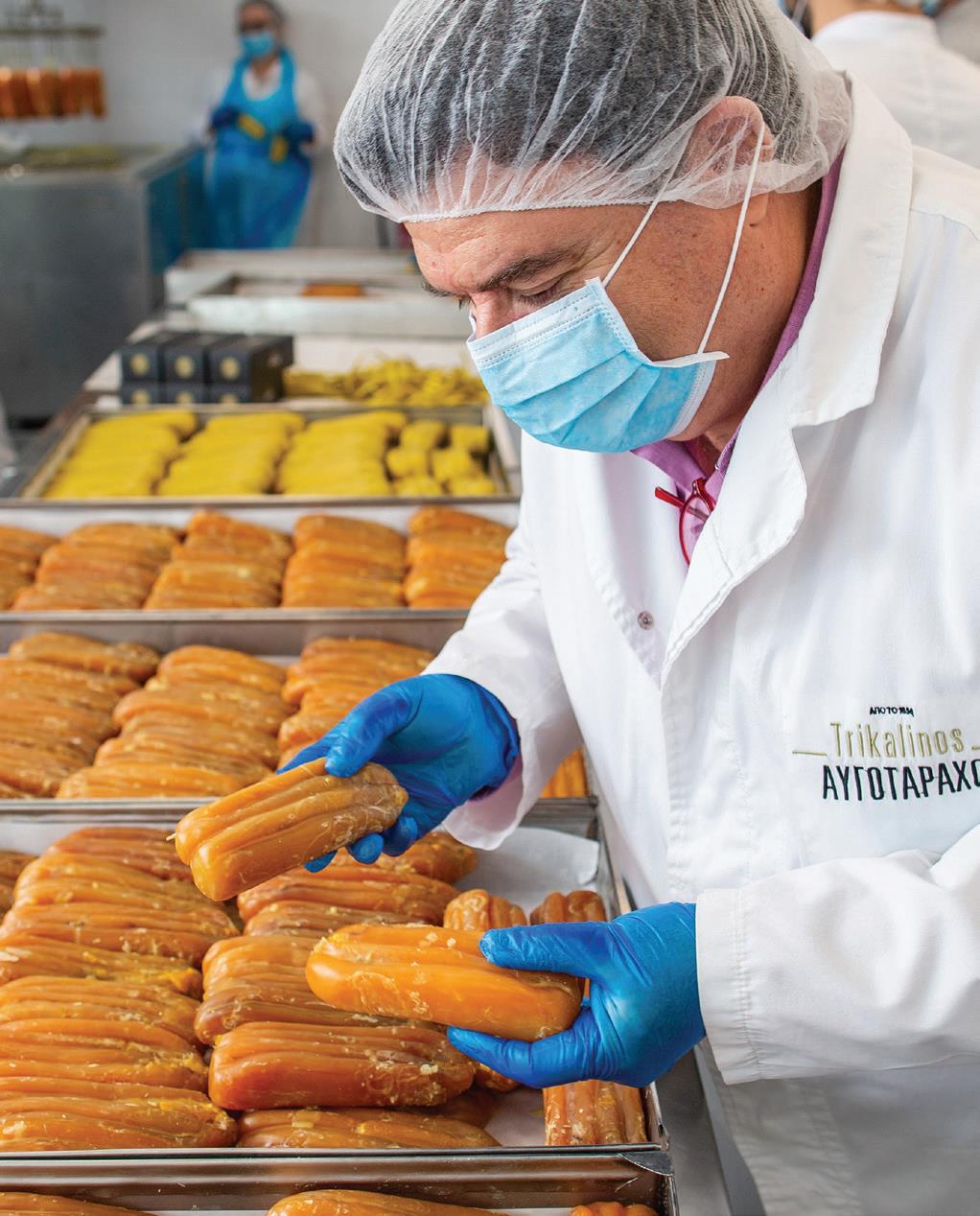
When Italian chef Michele Casadei Massari says that one of the best products Greece exports is Trikalinos Bottarga, he is confirming a path that has been 170 years in the making. The endorsement lands differently coming from an Italian.
Italy is one of the world’s great bottarga-producing nations, with Sardinia and Sicily having centuries of tradition behind them and an output that dominates global markets. The word “bottarga” itself is Italian. So, when a chef steeped in that tradition singles out a Greek product as exceptional, the question worth asking is: What exactly is he tasting?
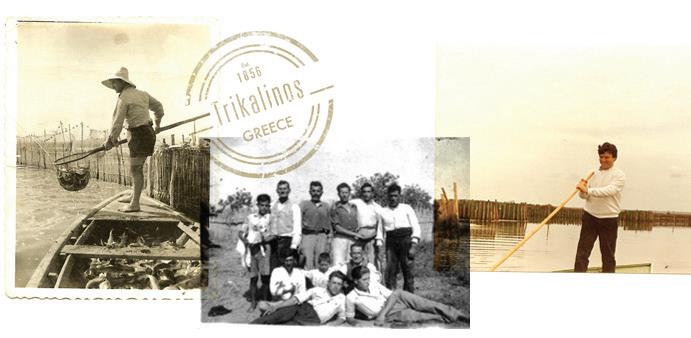
The answer lies in a lagoon town called Aitoliko, in the Messolonghi region of Greece, and it begins in 1856, when three brothers, Zafeiris, Nikos, and Giorgos Trikalinos, started producing and trading bottarga, cured grey mullet roe, known in Greece as avgotaraho, in the waters of Aitoliko. They were fishermen, as were their sons and grandsons after them, four generations who lived by the water. By 1942, Panagiotis Trikalinos, the most celebrated skipper in the local fisheries, had taken over. He was, by his son’s account, a man in a category of his own.
“My father had a unique connection with the sea,” says Zafeiris, fourth-generation owner of Trikalinos, who has led the company along with his wife, Lila, since 1995. “He could read the water, he knew exactly where the fish would be, how many sea bream, how many of each species. And he was always right.”
The memory carries both admiration and something harder to name. Panagiotis Trikalinos gave everything to the water. His children barely saw him. “It was exhausting work. The sea gave just enough to feed the family, to dress the children, to put them through school. But I couldn’t imagine that life for myself,” he adds.
For years, Zafeiris resisted the family business entirely. He worked as a government employee, in a different field, building a different life. The moment he changed course arrived without warning. He was walking to work one morning when he ran into his mother. “Son, what is it you’re really going after?” she asked. The question stopped him in his tracks. After thinking about it, he did what he believed was right in that moment. He handed in his resignation letter, walking away from a career he had spent years building. “And that is when things got hard,” he says.
The next day, he was at the hospital with his mother when he picked up a magazine. It was a dietary guide for patients with health conditions, and it listed bottarga plainly among the forbidden foods, a product that raised cholesterol, that should be avoided. He put the magazine down and couldn’t let it go. “I couldn’t believe that a product so full of goodness could cause harm. But I understood that it was the way we were making it.”
Reinventing a Product from Scratch
What followed was close to two decades of obsessive reformulation. The traditional preparation of grey mullet bottarga relied on heavy salting, so much salt that the product needed no refrigeration and could travel without a cold chain. The salt was the preservation mechanism, and inevitably it became the dominant flavor. “Before we made all these changes, avgotaraho was simply salt. It didn’t even need a refrigerator,” says Zafeiris.
He began pulling the salt out. He rethought the drying process, changed the production line, sent samples to the food chemistry department at the National Technical University of Athens, and eventually partnered with Harokopio University in Athens. The researchers found something that contradicted everything the diet guides had been saying: the reformulated product, tested in vitro, appeared to support arterial health rather than undermine it. The results were published in the Journal of Agricultural and Food Chemistry. A subsequent study with the Pasteur Hellenic Institute showed antiatherogenic effects. The product that had appeared in a hospital waiting room magazine as a health risk had become a peer-reviewed subject of nutritional research.
But the more immediate transformation was in the flavor. With salt reduced to below 2 percent, compared to the 5 to 6 percent salinity of a fresh fish and dramatically lower than conventional bottarga, the product became something entirely different to eat. “We have a product that unlocks all the taste receptors,” Zafeiris says.
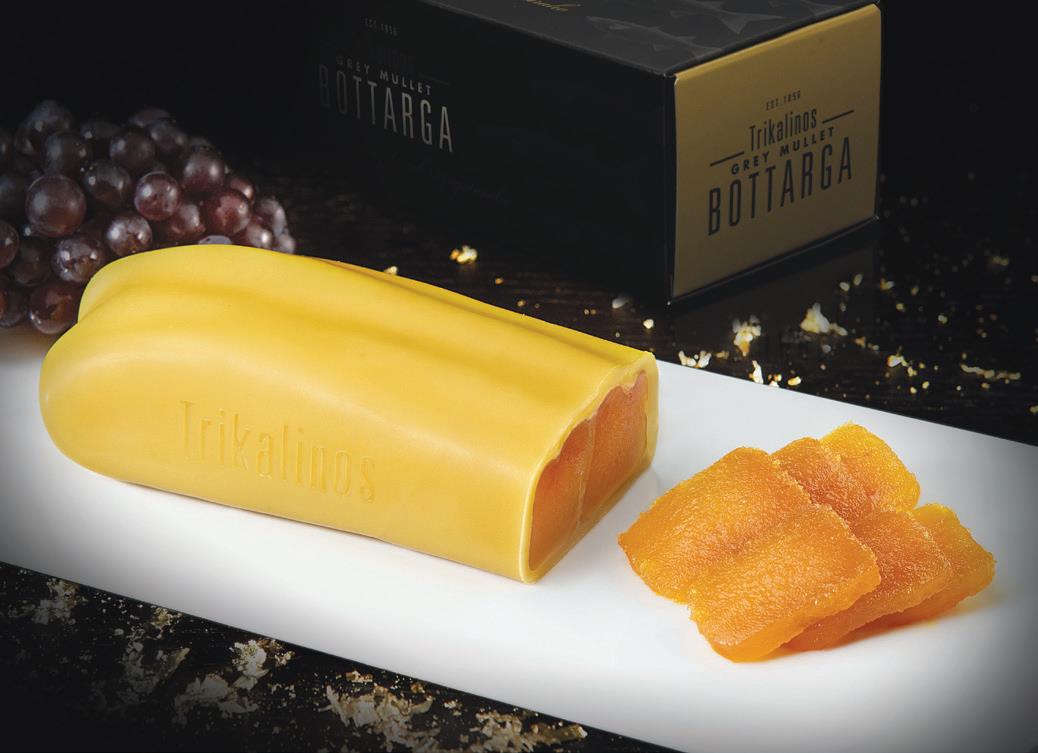
This is the distinction that matters most at the table. Conventional bottarga, including the celebrated Sardinian variety, delivers an intense, linear salinity. It is a preservation product that became a delicacy. Trikalinos bottarga delivers something more complex: moisture retained within the wax casing, flavors that shift and develop, a texture that calls up the sea without shouting it. The flavor, as Zafeiris puts it, comes from the product, not from the salt.
From Aitoliko to the World
The company moved its headquarters from Aitoliko to Athens in 2007, on the advice of the late Gerassimos Vassilopoulos, founder of the well-known Greek supermarket chain, who had become a mentor and advocate. The reasoning was practical: access to research laboratories, food safety certification, and the airport that would eventually carry the product to over 40 countries.
Exports began in 2007, with Petrossian in New York among the first customers. It was a statement of quality from the outset. The breakthrough that changed everything came through an exhibition in Japan, where a visitor was so struck by the product that he made some calls. That visitor had connections to Ferran Adrià, widely considered the most influential chef of his generation. In 2010, Adrià included Trikalinos among his selection of the 30 best products in the world and served it in his restaurants.
From there, the world came to them, though Zafeiris is clear that nothing arrived easily: “Everything we built came through hard work. Nothing was handed to us.” Over the years, collaborations followed with some of the world’s most celebrated chefs, among them José Andrés and Jamie Oliver.
Today the company ships to 43 countries, with France and Taiwan among its strongest markets alongside the United States. In Taiwan, grey mullet roe carries deep cultural resonance, given as a gift of good fortune at Lunar New Year, and the product found a devoted audience. In the United States particularly, their primary market is chefs and fine-dining restaurants, where the product has found its most natural home. Lila Trikalinos is the Head of Exports and Marketing and handles most communications with other markets.
The company has received acquisition offers over the years. Trikalinos has declined all offers. “I don’t connect work with what we’ll earn, but with what we’ll live by. And whatever we earn through work has to go back into the world,” says Zafeiris. And when journalists asked him during the 2010 financial crisis whether he planned to move the company’s headquarters out of Greece, his answer was unequivocal. “We have survived everything since 1856. It is the people who support you and love you, our people that we do this for. We would never consider leaving Greece.” Staying, however, comes at a cost.
Shipping costs from Greece remain punishingly high, and unlike other producing nations, Greece offers no export subsidies. There are markets the Italians have reached that Trikalinos hasn’t, not because the product isn’t good enough, but because the commercial infrastructure simply isn’t there yet.
The Fifth Generation
This year marks 170 years since the first Trikalinos brothers set out on the Aitoliko lagoon, and the fifth generation is already at the helm. Zafeiris’s son has joined the company as General Director. Succession in a family business is never straightforward, so much so that some business schools now teach it as a dedicated subject. Zafeiris is clear on this: Bringing children straight in is a mistake. They need to work elsewhere first, to understand what it means to build something before they inherit it.
For the Trikalinos family, this anniversary is as much about continuity as it is about celebration. The fourth and fifth generation together released two mousse products and a purée to mark the occasion, while the company has been replacing plastic packaging with paper wherever possible, a quiet commitment to sustainability.
As for what comes next, Trikalinos has no intention of reducing the range of products. “I see the products like my children,” he says. “I wouldn’t reduce them.” More, perhaps. Never less.
Panagiotis Trikalinos spent his life on the water, giving everything to the sea. His son chose a different path; the moment when a family tradition either finds the courage to transform, or quietly disappears. He chose transformation. He spent years in laboratories, reformulating a product that generations before him had made by hand, and carried it to markets across the world. The sea, his father used to say, gave just enough. Zafeiris Trikalinos proved that it could give much more.