From Pain to Possibility: Greek-American Amputee Embraces a New Life Through Osseointegration
Posted by estiator at 29 April, at 09 : 50 AM Print
CHICAGO — For decades, the story of limb loss has been defined not only by trauma, but by endurance—endurance of pain, limitation, and compromise. Today, however, that narrative is being rewritten. And for Greek-American Jerry Vasilatos, the transformation is nothing short of profound.
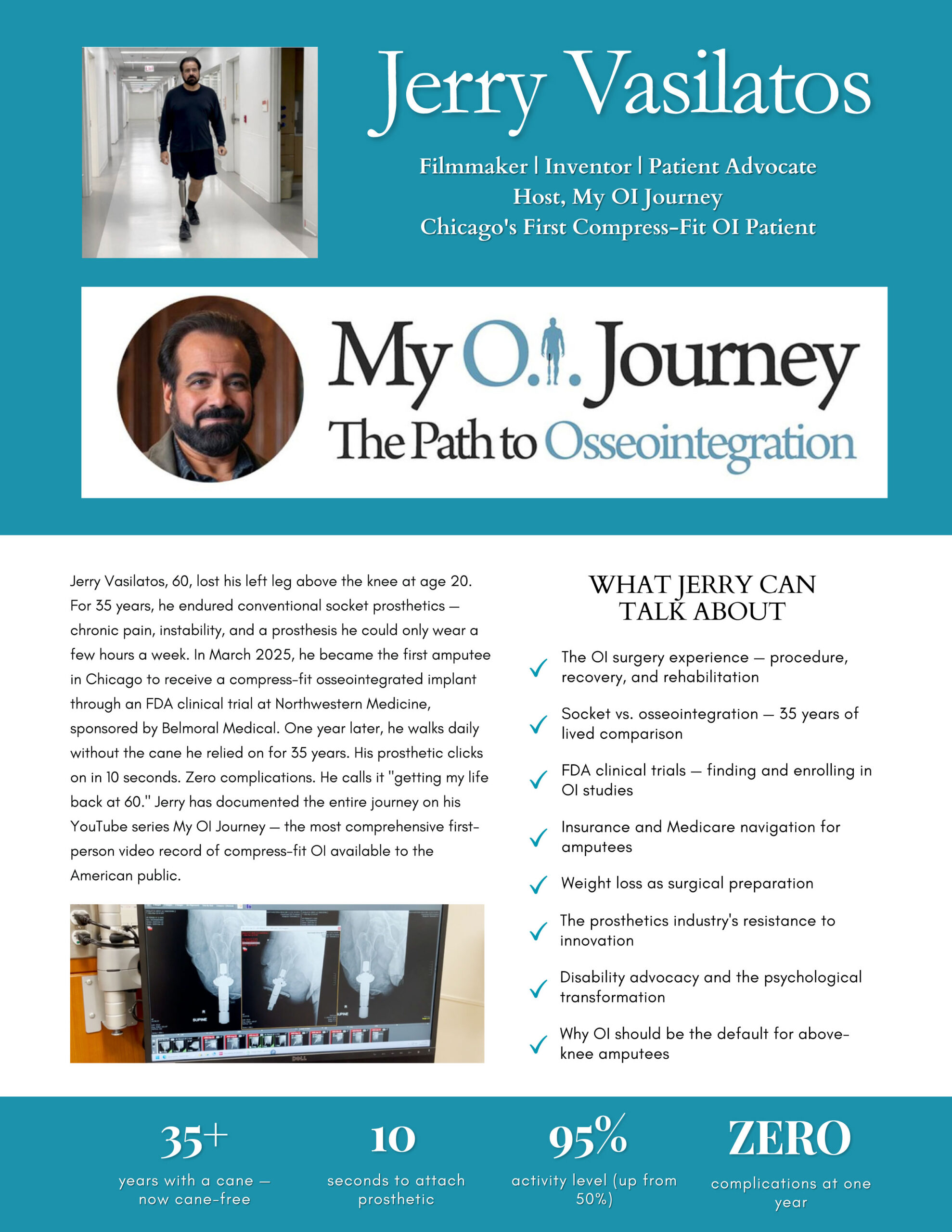
After more than 40 years of struggling with a traditional prosthetic leg, Vasilatos is walking—steadily, confidently, and, for the first time, pain-free. His journey, rooted in tragedy and culminating in cutting-edge medical innovation, offers both inspiration and a glimpse into the future of rehabilitative medicine.
A Life-Altering Moment
Vasilatos was just 20 years old when his life changed forever. Attempting to board a departing train, he misjudged the gap between the platform and the moving cars.
“As the train started to pull out of the station, I started knocking on the door… my foot went in between the platform and the train,” he recalled. “I got dragged about 40 feet.”
The injuries were catastrophic. His leg could not be saved.
Like many amputees of his generation, Vasilatos relied on a socket-based prosthesis—technology that, despite incremental improvements, has remained fundamentally unchanged for centuries. The device attaches by suction around the residual limb, often causing friction, instability, and chronic discomfort.
“After three or four hours, you are sweating. It’s digging up into your groin,” he said.
Over time, the pain and inconvenience became so overwhelming that he often abandoned the prosthetic altogether, turning instead to crutches or a wheelchair.
Discovering a Breakthrough
Everything changed in early 2025, when Vasilatos encountered a procedure known as osseointegration—a technique more widely used in Europe and Australia, but still emerging in the United States.
“I stumbled across—and that is no pun intended—a new process,” he said.
Unlike traditional prosthetics, osseointegration eliminates the socket entirely. A titanium rod is surgically implanted into the femur, where bone tissue gradually fuses with the metal in a process known as biological integration. The prosthetic limb then attaches directly to this implant, creating a stable, skeletal connection.
“They let the bone grow around it, so it becomes literally an extension of your skeletal system,” Vasilatos explained.
This direct attachment transforms not only mechanics, but sensation. Patients often report a phenomenon known as “osseoperception”—a subtle but meaningful ability to feel the ground through the prosthetic.
Precision Medicine in Chicago
Vasilatos underwent the procedure as part of a clinical trial and began rehabilitation at the Shirley Ryan AbilityLab, one of the world’s leading centers for physical medicine and bionic research.
There, prosthetists like Landon Davis have spent years refining the integration of advanced prosthetics with the human body.
“Osseointegration can lead to the most intimate forms of connection between the prosthetic leg and a person’s residual limb,” Davis noted.
Dr. Levi Hargrove, a leader in neural engineering for prosthetics, believes the technology is poised to become mainstream.
“For a large portion of the lower limb amputee population, they are going to choose to wear this technology,” he said.
A New Way of Walking—and Living
For Vasilatos, the results have been transformative.
“You are not wobbling around in the soft fleshy tissue… It is your bone controlling things. It is completely stable underneath you.”
While he acknowledges a slight limp remains, the difference is remarkable.
“Now it’s like I got my real leg back… It’s just amazing.”
Beyond mobility, the impact extends to overall health. Freed from the limitations of his previous prosthesis, Vasilatos has regained independence, increased his activity level, and improved his physical condition dramatically.
Risks and Realities
Despite its promise, osseointegration is not without challenges. The procedure requires a lengthy recovery period and carries risks, including infection at the skin-implant interface. Patients must also avoid high-impact activities.
Still, for many, the benefits outweigh the risks—especially for those who have struggled for years with traditional prosthetics.
A Message to the Community
As a filmmaker and storyteller, Vasilatos is now using his voice to advocate for awareness. His message is simple but urgent: amputees deserve to know their options.
“I want other amputees, other limb-loss survivors to know how good this feels,” he said.
For the Greek-American community—long associated with resilience, ingenuity, and contributions to medicine—his journey resonates deeply. It is a modern expression of a timeless ethos: to endure, to innovate, and ultimately, to transcend limitation.
The Future of Limb Restoration
Osseointegration represents more than a technological advancement—it signals a paradigm shift in how medicine approaches disability. By anchoring prosthetics directly to the skeleton, clinicians are moving closer to restoring not just function, but wholeness.
As research expands and access grows, stories like that of Jerry Vasilatos may soon become less extraordinary—and more expected.
For now, however, his steps—steady, pain-free, and determined—mark the leading edge of a new era.